
The journey to the General Quadratic Formula is a long one. It should begin where there reader is, but I don’t know where that is. As a consequence, I will try to begin a little behind the reader so that I may after a short while catch up with him and then we may journey forward together.
Let us begin with the binomial. A binomial is an expression that has two terms connected by a plus sign, i.e.

Let it be understood now that  and
and  are stand ins. They might be representing complicated expressions. For example,

is a binomial with  being replaced by $xy$ and
  being replaced by
  , and
, and

is a binomial with  being replaced by
  and
and  being replaced by
  .
.
Let us now take two such binomials  and
and  and watch them interact. That is to say I will multiply
  by
by  .
.
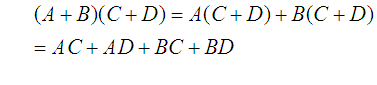
or, to summarize,

We will, for the most part, be concerned with a special case of this in which $A=C=x$. In this case,
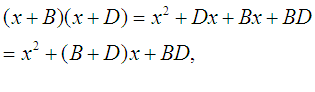
or, to summarize,

That quadratic polynomial thing
Now recall the expression 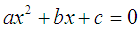 of the first chapter. Since
  , I can divide both sides of the equation by it and not change the value of
  required for the equation to hold true. That is to say, I can consider
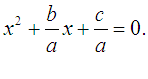
If I am able to find values of  and
and  so that
  and
and  , then
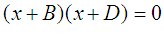
so that either  and
and  , that is to say
  or
or  .
.
There are special cases in which we can, by trial and error, find  and
and  . Pursuing solutions in this way in an entertaining mental exercise similar to Sudoku, but, for practical purposes, a more general method is required and that general method is the General Quadratic Formula in whose derivation we are currently proceeding.


 Okieinexile's Blog