
By Bobby Neal Winters
The old saying about not being able to tell a book by its cover is both true and untrue.
We live in a complicated world.
On one hand, as our Lord said, there are some people who are like white-washed sepulchres, all clean and pure on the outside, but full of rottenness and death on the inside. On the other hand, if there is cleanness and pureness on the outside, you can tell that someone has expended some effort to put it there.
Last week as I write this, I obtained some Spanish Cedar at the Woodcraft Store in Tulsa. Spanish Cedar is different than the Eastern Red Cedar that we have around here. Spanish Cedar has the scientific classification Cedrela ordorata while Eastern Red Cedar has the classification Juniperius virginiana. Spanish Cedar is a true cedar, but Eastern Red Cedar is a juniper. They aren’t even of the same genus, but they both smell very nice when you work them.
All that aside, I got the Spanish Cedar because it looked like it would be nice to work with. I wanted to make the head of a recorder with it, because it is said to handle the moisture well.
So yesterday, I cut off a chunk of it, put it on my lathe, and turned it. It turned beautifully and smelled wonderfully as I worked with it. I had my garage door open and, as Jean came down the driveway, she remarked on how good it smelled.
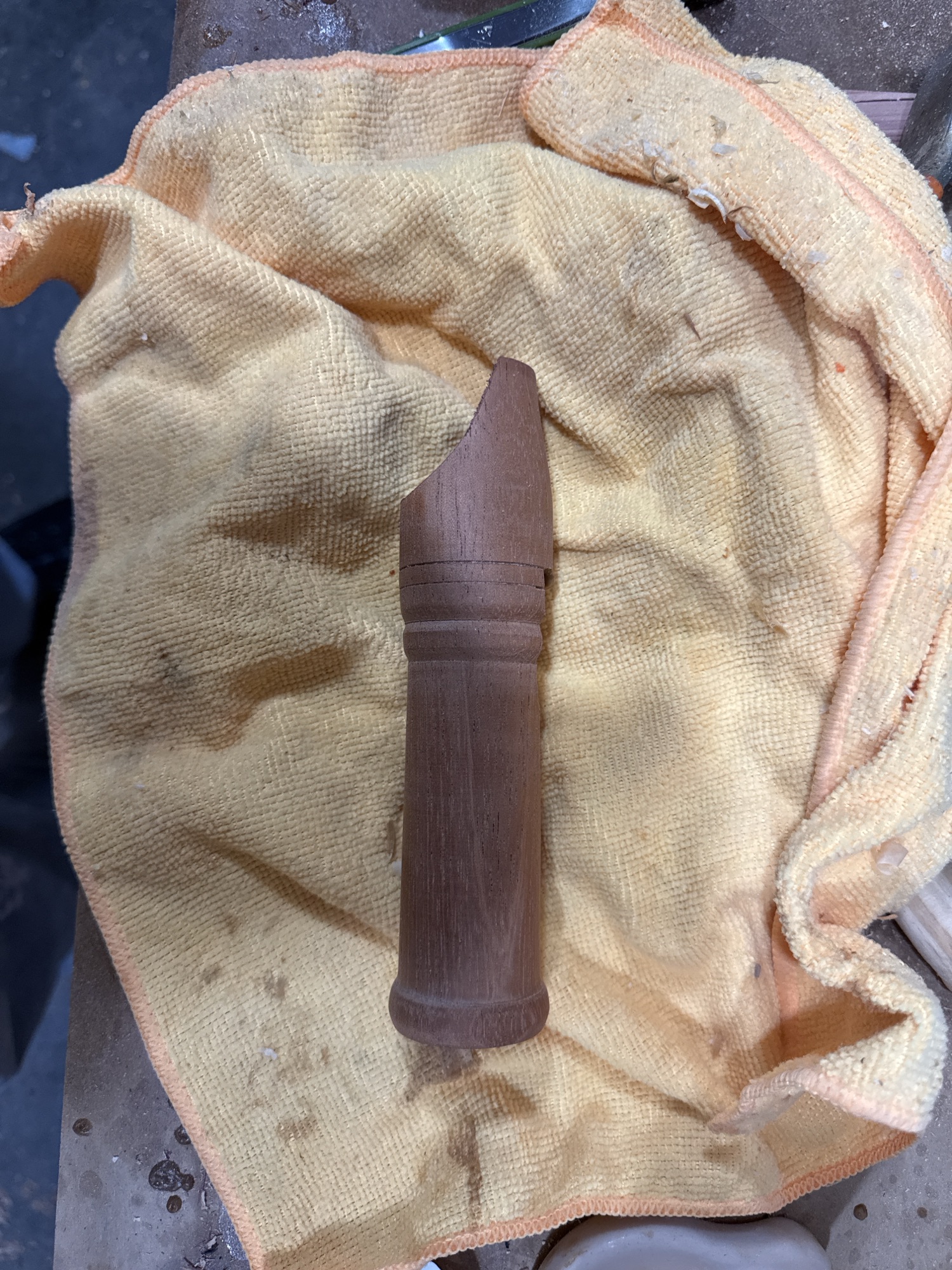
Not only did it smell good, but it was nice to work with. I hollowed it out, and then shaped it nicely. I measured the window (i.e. the first hole where the air comes out) very carefully. I hand-carved it very carefully.
I took pains–great pains in my mind–to measure everything carefully. I shaped my block, slid it into place, and then I blew down the windway to test it. And I heard….
Air.
I heard plain, unmodulated air.
There was no whistling sound, whether annoying or pleasant.
As I looked it over, I saw that–as careful as I thought I was being–I had made a mistake in my construction. I won’t be too specific because it would really be boring. Suffice it to say it’s not the sort of thing that can be easily fixed.
So, with great care and concentration, I created a beautiful recorder head that cannot, in its current state, be used for its intended purpose.
If I were trying to start a fire, I could use it as kindling; if I needed something to carry pills in, I could use it that way; as I am a writer, I will use it as a metaphor.
If you were to look at this piece, you would recognize that it was made by someone who’d taken his time with it.
I’ll just say it: It’s pretty.
But there is something wrong on the inside. There is a flaw within it that keeps it from being what it needs to be.
But it is pretty.
And I have some time invested in it already.
And–I don’t know if I said this before–they don’t just give Spanish Cedar away.
So I will keep it out of harm’s way and I will revisit it from time to time. I will think about what I might possibly do to fix it.
In the meantime, I have a new book. It’s entitled “The Amateur Wind Instrument Maker” by Trevor Robinson. It is kind of odd that it is coming to me now. For weeks I have been searching videos, web pages, etc for specific information on how to make recorders. None of the searches that I put into Amazon brought me anything.
Then, earlier this week, this book popped up in my Amazon suggestions, I ordered it, and it arrived today. I flipped to the section on recorders and began to read. On page 39 it says: “The top joint is the crucial part of the recorder. Great precision is required in its construction, therefore the recorder is one of the most difficult instruments to make.”
If I had come upon this before I started on this journey, I can’t say that I would’ve started. Things might’ve gone very differently.
But I did get started; I am hooked; and now I have a book.
I will let you know any progress I make, even if it’s only metaphorical.


 Okieinexile's Blog