The View from the Drawing Board
By Bobby Neal Winters
I will not bore you with details. My recorder, my beautiful recorder, is dead. I drilled holes in it and it died.
It died almost without a sound, its last breath a rasp.
Back to the drawing board.
That last sentence was seriously considered. I thought about saying that I am back to square one, but that isn’t true. I am farther along than when I first started this journey. I’ve learned skills; I’ve learned things that I didn’t know; I’ve learned about the instrument.
I’ve also learned that I’ve been a bit naive, but–to be open–I already suspected that.
So no, I am not back to square one. I’ve got a book now; I’ve got a notebook; and–this is very important–I’ve obtained a couple of inexpensive plastic recorders that I plan to copy.
The pairing of the book, The Amateur Woodwind Maker, by Trevor Robinson and the acquisition of the actual, albeit plastic, instruments has been very important. The book talks about people who’ve studied and reverse-engineered classical instruments in order to replicate them. This gave me permission to do the same thing. For some reason, I needed it. Interesting.
However, I don’t have access–nor should anyone give me access–to classical instruments. I can, however, order some plastic ones on the internet and have them arrive on my front porch in a fairly short time.
I can take them apart, measure the pieces, measure the bores through the center. Put them together and measure the holes and measure the distance between the holes.
I’d been given a set of calipers as a Christmas present a few years ago that is turning out to be quite useful.
In addition to this I have–reluctantly–bought myself a metric tape measure.
Rest assured this was a last resort.
Here’s the thing. In the book I mentioned, all of the measurements are given in millimeters. To not put too fine a point on it, converting from small numbers of millimeters to inches–indeed to 16ths or 32nds of an inch–is a nightmare. It’s best to measure in millimeters to begin with and be done with it.
I will probably have to buy some metric drill bits for the holes, but I am going to put that off as long as I can.
I’ve also decided that it’s time to quit working in soft wood. It is easy to work with, true, but it’s also easy to mess up. And right now, I am only using small pieces of wood.
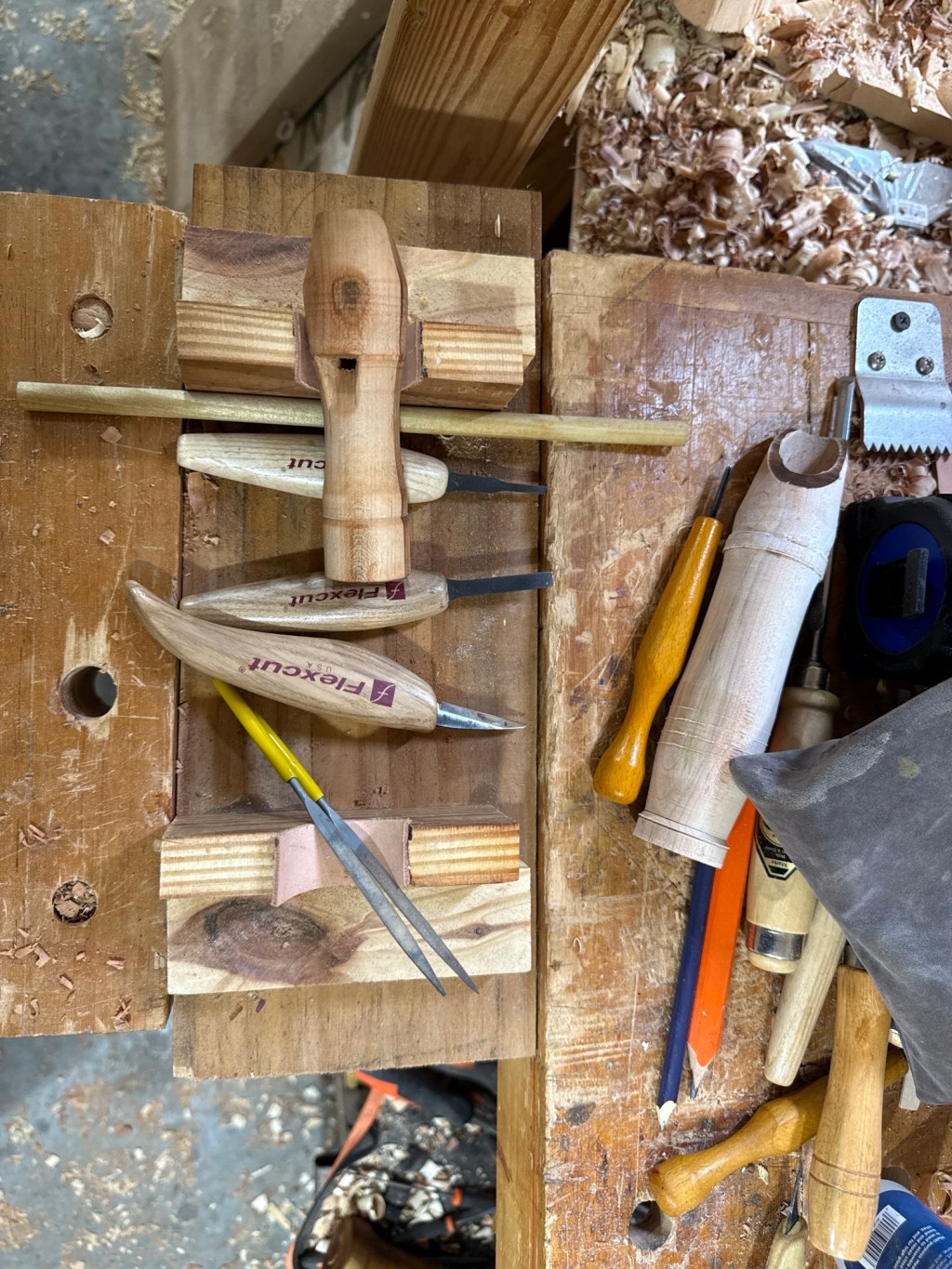
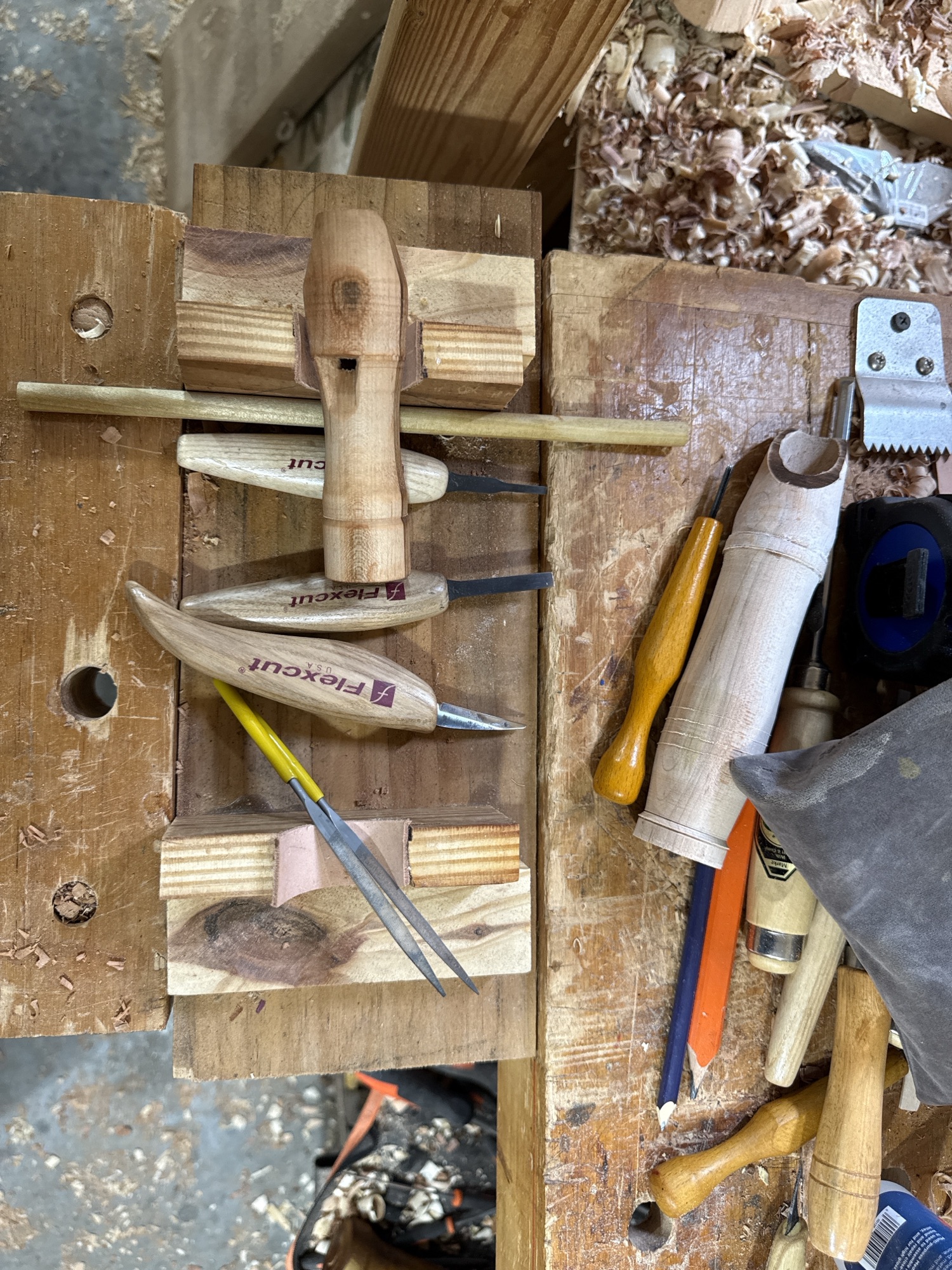
I am concentrating on making the head joint of a soprano recorder. This is about 4-and-a-half inches long (you can’t break me, metric system) and about an inch in diameter. So even when–and that’s a when and not an if–I mess up, it’s not as expensive monetarily.
It’s almost always emotionally expensive.
It’s somewhat ironic that I got into this project through my lathe. I’ve progressed with my lathe techniques to the point where it doesn’t take me all that long to do that part of making a head joint. The time-consuming part comes with making the windway, the window, and the labium, i.e. the edge where the sound is made.
At this part of the operation, I am mainly using hand tools (though I do bring in a Dremel from time to time). I’ve obtained a broaching tool, and I make use of chisel-like knives (or knife-like chisels, whichever way your brain is wired) and tiny jewelers files.
I will say it can be frustrating, but there are very few feelings to compare with taking a head joint that is basically a pipe with a hole in it and filing it in the right places until it makes a sound. You get a nice little dopamine rush when that happens, let me tell you.
(It occurs to me that the casinos design the slot machines to take advantage of this. Perhaps I need to reflect on this before I buy any more metric tools.)
Anyhow, I am back at the drawing board, but that’s okay.
Bobby Winters grew up near Harden City, Oklahoma. He teaches mathematics and computer science, does woodworking, and blogs at okieinexile.com.
 Okieinexile's Blog
Leave a comment