By Bobby Neal Winters
The mowing season has begun for me.
And I include that prepositional phrase “for me” with intention. The mowing season has a rolling start. Every lawn is different.
You’ve been conditioned to expect me to now say that all are special. Well, maybe. The word “special” carries a lot of weight, if you get my meaning.
This year I’ve gotten a later start on mowing than my friends and my neighbors, in some cases by a couple of weeks. There are a couple of different reasons for that.
One of the reasons is a decision that I made proactively with my mowing last year. Last season I purposefully ended my mowing with a late mow. I waited until the grass was dormant and some leaves had fallen and then I mowed. One reason to do this is that you get a quick burst of green in the spring. (This actually happened and it was quite gratifying.)
Another reason is that doing this reduces the amount of dead trash that you will have to mow through when spring comes.
The lateness of my first mowing is evidence that this worked for me. It worked this year, at least. I don’t want to draw a bullseye on my back for the gods of mowing or for the Devil (maybe they are the same!) by thinking I’ve distilled a universal law.
Regardless of the lateness of my start and the reasons thereof, my first mowing of the 2026 season is now in the books. Let me share a report of the experience with you.
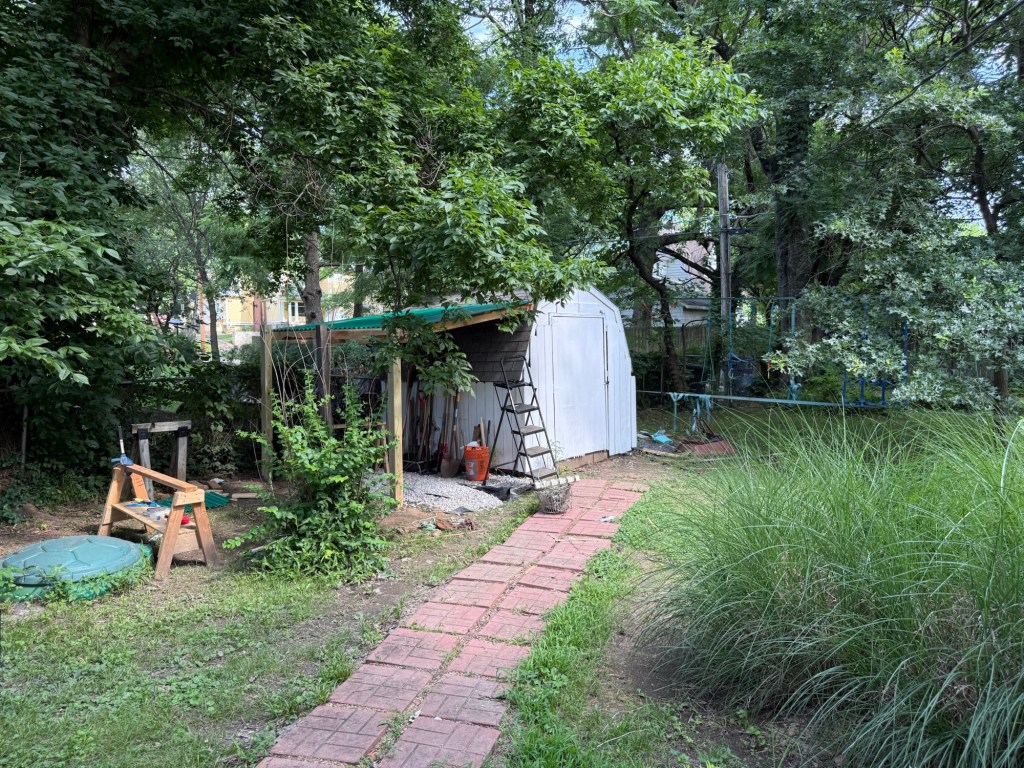
I’ve only done the back yard. The rest of the lawn still doesn’t need it for various reasons. The back yard took one-and-a-half hours. When the mowing season is mature, it usually only takes an hour. The first mowing always takes longer. This is due to multiple factors.
Earlier in this piece, I referred to every lawn being “special.” One of the ways my lawn is special is the number of voluntary native plant species which make a home within it. Some folks would refer to these plants as “weeds,” but my wife took classes in Weed Science at Oklahoma State University. (Laugh at that if you like, but there is money to be made in weed science, and not just the illicit weed if you get my meaning.)
There is a technical definition of a weed. A weed is any plant that is growing in some place that you don’t want it to grow.
I’ve been living at my current location for about 36 years now. These plants have been there that entire time. For an extended period, I fought a war to get control. Some of the plants that were there in the beginning are no longer there. This may be due to my efforts, but more likely, it is due to acts of God. In any case, the plants that remain have resisted my efforts and, in some cases, have flourished.
All of that to say, my desires have had no discernable negative impact on their location. They are thriving. At some point, I made a decision–consciously or unconsciously–that if I was to be happy, I was just going to have to accept their existence. Because of this, I have a robust collection of voluntary native plant species.
The thing about native plant species is that they are accustomed to our climate. (It sort of goes along with them being natives.) So they take advantage of spring when it comes. Because of this, they are up big and tall this time of year. This adds to my mowing time. By the time the season has matured, they will be more in line with the multiple varieties of domesticated ground cover that co-exist within my lawn.
The first time I wrote that last sentence, I used the word “grass” instead of “domesticated ground cover.” I rewrote it for the sake of scientific accuracy as this is intended to be a formal report. In addition to my collection of robust native plant species, my lawn is also a historic museum of the types of ground cover that have been advocated for over the last 150 years this town has been in existence.
I have clover. I have bee balm. I have more different species of grass than I can classify and as far as I know, none of them is a species of native grass.
They say that if you want to discover a new species that you only need to look in your own back yard. They must have been thinking of me.
In addition to the mowing time, there is also a winter’s worth of policing the yard for fallen limbs, grandchildren’s belongings, dog toys, etc.
All of this put together, and I got an hour-and-a-half fully-body workout.
It’s good to have this one in the books. It’s all downhill until this time next year.Bobby Winters grew up near Harden City, Oklahoma. He teaches mathematics and computer science, does woodworking, and blogs at okieinexile.com.
 Okieinexile's Blog
Leave a comment