Government work and hand grenades
By Bobby Neal Winters
I’ve been thinking about numbers.
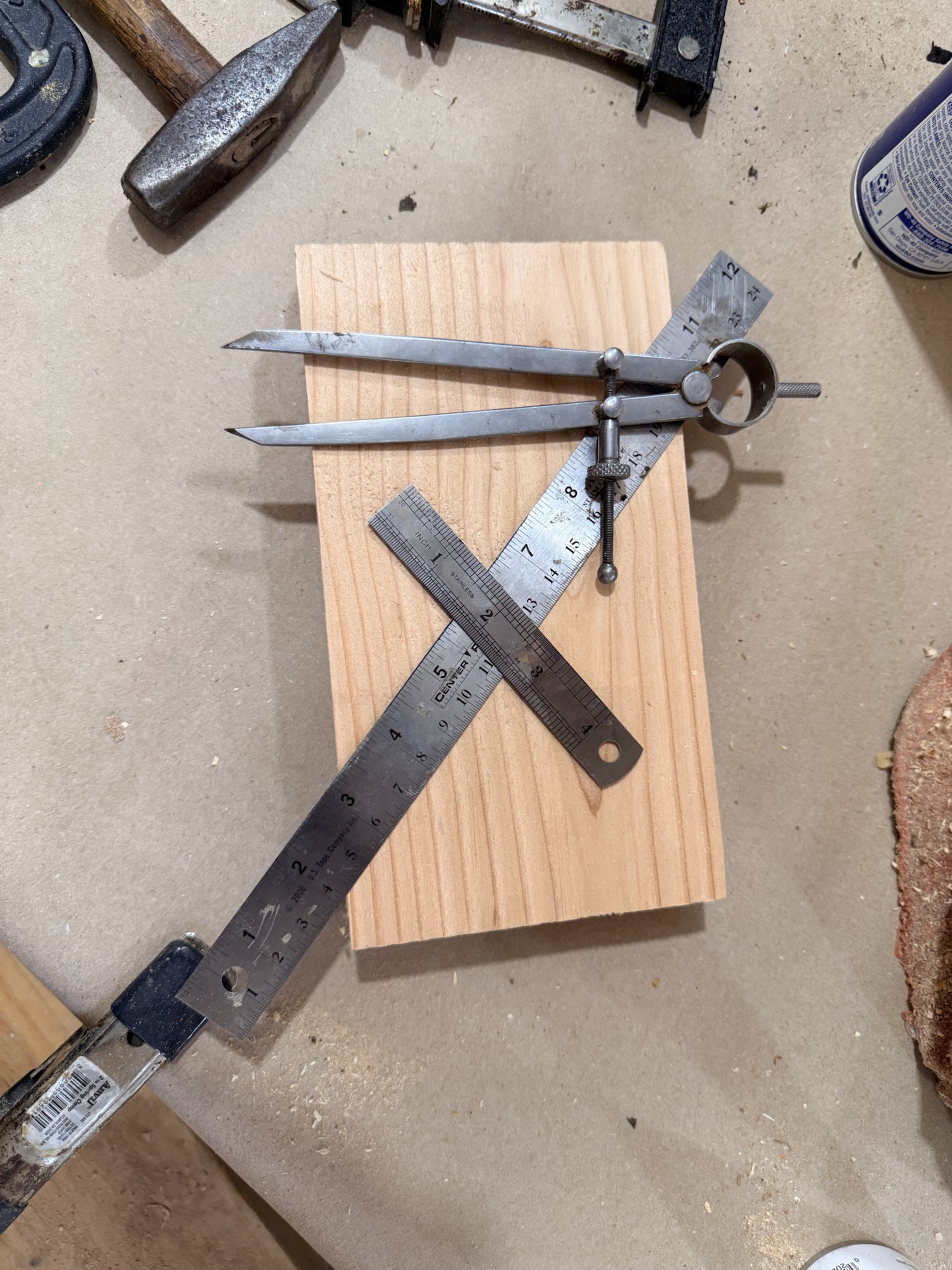
Say that you want to measure the distance between a pair of marks on a board. Say that you’ve been given a fixed unit to measure it in. The unit could be a meter, a yard, or a cubit.
It doesn’t matter.
The unit has been established and there is no changing it. It is set in concrete, as it were, because you have to use it to communicate with the rest of the work-crew.
With the unit chosen, you can begin to measure the length of a board. You can think about taking your cubit, say, and starting with one end lined up with one end of the board. You can then make a mark where the other end is and slide the cubit along, at the same time you keep a tally of how many times you have to do this.
You are using integers to keep track of how many times you lay out the cubit on the length of the board.
Now some of you are thinking ahead and see a problem with this: Unless you are suspiciously lucky, this is not going to come out even. That is to say, the last time you put down your cubit, the far end is not going to exactly line up with the end of the board. It will either overlap or fall short.
What do you do?
If you are in the position of saying, “Close enough for government work” or “Close enough for hand grenades,” you stop. If that is not the case and you need precision, then you subdivide the cubit, your agreed upon unit of measure, into a fixed number of subcubits of each of which has the same length as all the others.
The number of subunits you use depends on the accuracy that you need: The more–and consequently smaller–subunits, the greater accuracy.
For example, when we start out with yards, we first subdivide them into feet. We could describe an object as being 3 or 4 yards long. When we subdivide to feet for greater accuracy, we might write it as 3 yards and one foot, and abbreviate it to 3y 1’, with the single apostrophe to indicate our first subdivision.
If we need greater accuracy, we could subdivide further into inches. Our board might be three yards one foot and 3 inches which we would write as 3y 1’ 3’’, with the double apostrophe denoting that this is our second level of subdivision. (This same sort of thing is done when one is measuring angles or time. The fact that seconds is denoted by a double apostrophe is an essential part of the nomenclature.)
The thing is, we probably wouldn’t write this distance using yards. The yard just isn’t big enough in relation to the foot to justify its use in this context, so we would write this as 10’ 3’’. If we had to do any serious math with this length, we would switch it into the finest units and say it’s 123 inches.
Here is the place where we can see the advantage of the so-called metric system. The metric system begins with the meter as its standard unit of length and whenever an extra level of accuracy is needed, it divides by 10, so as to be in harmony with the base-10, place-valued technology we currently use to deal with numerical operations.
The length of the board could be described as being 3 meters at first approximation. Then, theoretically, you could say 3 meters and one decimeter 1; for more accuracy you could–again theoretically–say 3 meters, 1 decimeter, and 2 centimeters.
But you wouldn’t. You would say 312 centimeters. This is a transparent connection to all the levels. It has the advantage of telling you the level of accuracy at a glance: The actual length is somewhere between 311 centimeters and 313 centimeters. You can never trust that last level of calibration.
Even the fussiest carpenter or scientist will get to the point of being satisfied with a fairly accurate approximation, government work and hand grenades being what they are.
Mathematicians are not. The numbers that mathematicians call “Real Numbers” have been identified with this model of measuring a board I have just described. The history of this way of thinking goes at least as far as Euclid. Mathematicians have shown that you can never calibrate finely enough with any number system to measure every length exactly. Someone will always have to invoke either government work or hand-grenades.
That’s just the way it is.
But we insist that there is a number that represents the length exactly. We can’t see, we can’t smell it, but we know that it is there.
Bobby Winters grew up near Harden City, Oklahoma. He teaches mathematics and computer science, does woodworking, and blogs at okieinexile.com.


Leave a Reply