By Bobby Neal Winters
I finished the beehive for my daughter and my second cigar box guitar at the same time.
I took it as a sign.
The weather was nice: neither too hot nor too cold.
Also a sign.
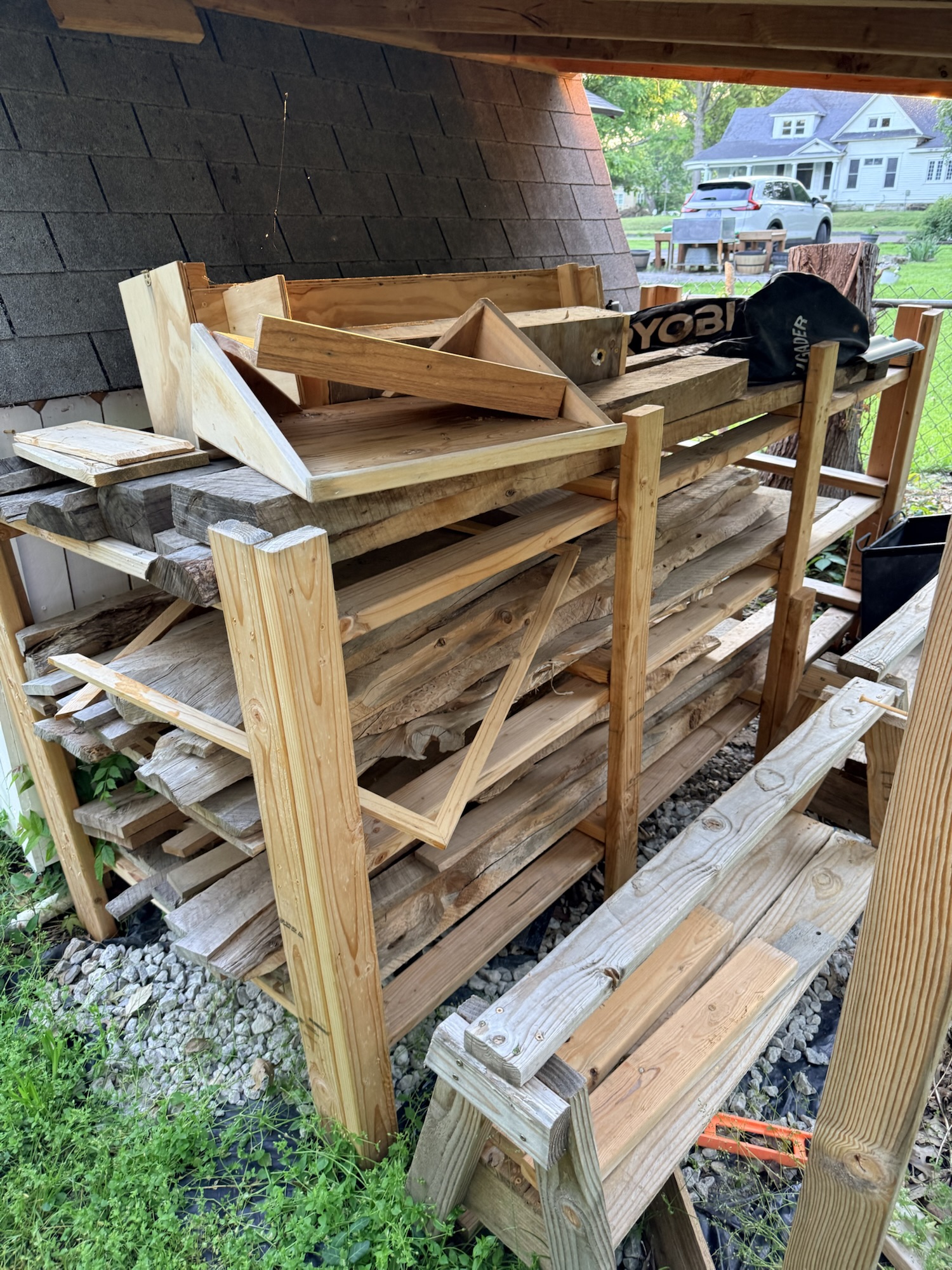
So I opened up my garage-woodshop and began the process of cleaning.
I am not using the right word when I say “cleaning,” but I will leave it there because it’s one people understand. One word doesn’t really do the job because when I replace “cleaning” with “ordering,” it doesn’t really fit into English correctly. I might be well advised to say “to put in order,” following God’s instructions to Hezekiah: “Put your house in order. For you are dying, and will not live.”
Before anyone gets worried, I am okay. Don’t take the fact that I am putting my workshop in order as a sign that I’ve received a bad diagnosis.
But, in the course of my own journey in learning how to do woodworking, I’ve gone through my father-in-law’s old tools and because of the way he organized things, I’ve reinforced–at very least–the respect that I had for him. The way he had his tools in order taught me things, things about how he did things and things about him.
I would like the people who follow me as I follow him to have a similar experience. Whether I die in my sleep, having completed a perfect recorder, or bleed to death on the floor of my shop at the base of the tablesaw, surrounded by fingers, I want whoever inherits my workshop to learn something good about me when they go through it.
Maybe that’s vanity. If so, I will own it.
Now that I’ve said all of this, I realize something else. I was only able to appreciate my father-in-law’s tools and his organization of them after I’d learned a bit about those things myself. The knowledge about him was there, stored in his old tools, in his old shop until through learning my eyes were open and I became able to appreciate it.
Here I come again to the importance of knowledge and knowledge’s relation to the very existence of the world.
Let’s go back to my favorite tool: the chisel. You can use a chisel for a lot of things: making mortises, making half-laps, making dados. You can use a chisel to cut a board in two if you don’t have a saw. If you have a saw, for goodness sake, use the saw, but still you can do it.
You can do all of that through knowledge of how to do it.
If you don’t know what a chisel is, but just happen to come upon one, you might use it as a sinker for your trotline, and what a waste that would be.
On the other hand, if all of the chisels in the world were to disappear today, but the people who knew how to use chisels remained, chisels could be brought back in a day.
In some sense, the chisel isn’t the beautifully crafted piece of metal, it is the knowledge of the thing. It exists as a part of human culture.
We as humans share this knowledge through the teaching and learning of practices. We share it through speaking, through videos, and through writing.
Sometimes we do our writing in subtle ways. We write messages to those who follow us by the way we order our environments, by the shape we leave our shops in.
I am not saying that your shop needs to be sterile. Mine certainly won’t be. At any given time, the question is not whether there is sawdust, wood chips, and piles of shavings, but how much of each.
That’s just the sign of a shop in use.
There is an order that lies beneath the detritus of living. That is what I am working on. That is what I hope those who follow me find once I am gone.
Bobby Winters grew up near Harden City, Oklahoma. He teaches mathematics and computer science, does woodworking, and blogs at okieinexile.com.


Leave a Reply